
Series and parallel circuits: compare current and voltage
- Objective
- Measure the voltage across each lamp and the current in each part of a series and a parallel circuit, and find the rules for how voltage and current divide in each.
- Level
- Middle and high school
- Time
- 45 minutes
- Topics
- Series circuits, parallel circuits, current, voltage, resistance
Steps
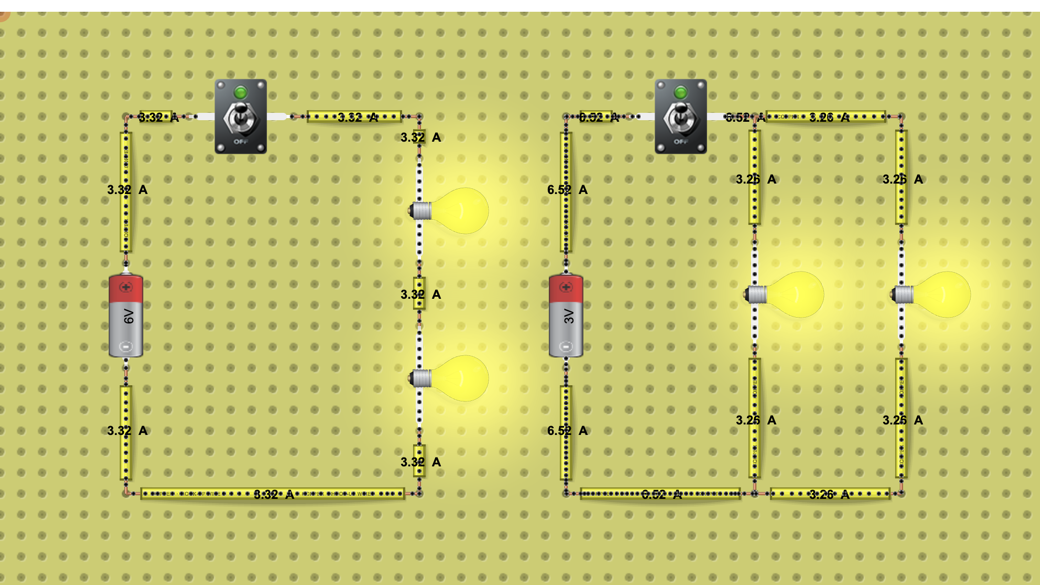
- Look at the two circuits: a 6 V battery, a switch and two lamps in series, and a 3 V battery, a switch and two lamps in parallel.
- Press Open in the lab. Both switches are already closed, so all four lamps light; compare how brightly they glow.
- The circuit has no meters, so add a digital multimeter. Set the dial to DC voltage on the 20 V range and put the probes across each lamp and each battery in turn. Record every reading.
- To read currents, click a wire and tick Show Ampere in its property panel. Check the wire next to the 6 V battery, the wires on both sides of the series lamps, the wire to each parallel lamp and the wire next to the 3 V battery.
- If you measure current with the multimeter instead, connect it in series and use the 10 A range: the currents in this circuit are several amperes.
- Before you change anything, predict what happens to the other lamp when one lamp is removed from each circuit. Then remove one lamp from each circuit and check your prediction.
Data table
| Circuit | Measured at | Voltage (V) | Current (A) | Brightness |
|---|---|---|---|---|
Questions
- In the series circuit, how does the current compare at different points in the loop?
- In the series circuit, what is the voltage across each lamp, and how do the lamp voltages add up?
- In the parallel circuit, what are the voltage across each lamp and the current in each branch? How does the current from the battery compare with the branch currents?
- Use V = I × R and your readings to find the resistance of one lamp, then the total resistance of each circuit.
- The series lamps run on 6 V and the parallel lamps on only 3 V, yet all four glow about the same. Why?
- What happened when you removed one lamp from each circuit? Explain it.
For teachers
Answer key
- It is the same everywhere: about 3.31 A. A series circuit has only one path, so the same current passes through every part.
- About 2.98 V across each lamp; together 5.96 V, almost the battery's 6 V. The last 0.03 V is lost inside the battery (internal resistance 0.01 Ω × 3.31 A ≈ 0.03 V).
- Each lamp has about 2.93 V across it and about 3.26 A through it. The battery supplies about 6.52 A, the sum of the two branch currents (3.26 A + 3.26 A).
- One lamp: R = V ÷ I = 2.98 V ÷ 3.31 A ≈ 0.90 Ω (2.93 V ÷ 3.26 A gives the same). Series: 0.9 Ω + 0.9 Ω = 1.8 Ω, so I = 6 V ÷ 1.81 Ω ≈ 3.31 A with the battery's 0.01 Ω. Parallel: 0.9 Ω ÷ 2 = 0.45 Ω, so I = 3 V ÷ 0.46 Ω ≈ 6.52 A.
- Each lamp gets about 3 V either way: the series lamps share 6 V, while each parallel lamp has the full 3 V. So the power per lamp is almost the same: about 2.98 V × 3.31 A ≈ 9.9 W in series and 2.93 V × 3.26 A ≈ 9.6 W in parallel.
- In series, the other lamp went out: removing a lamp breaks the only path, so no current flows. In parallel, the other lamp stayed lit with about the same brightness, because its branch is still connected to the battery; the battery current drops to about 3.3 A (3 V ÷ 0.91 Ω).
Frequently asked questions
Can students do this at home?
Yes. The lab runs in a web browser, and anyone can open this public circuit, run it and change it without signing in. The copy on this page pauses after two minutes; Open in the lab keeps it running.
Do students need an account?
Not to run the circuit and take measurements. They need a free account to save their own copy, and to hand the work in as an assignment they join your class through its join link.
Why are the currents so large?
The lamps in this circuit have a resistance of only 0.9 Ω, so a few volts drive several amperes. It is a good moment to talk about meter ranges: on the multimeter, these currents need the 10 A range.
Teaching with circuits?
Create a classroom, give your students this lab, and review what they submit. The free classroom demo gives you one classroom with room for 30 students for 7 days, counted from when your first student joins (once per teacher); after that it keeps up to 5 students.
Try the free classroom demo