EDUCATIONAL GOALS FOR DCACLAB
The DCACLab is implemented for the purposes of developing and reinforcing knowledge and skills necessary for supporting mastery of objectives of the lesson. It allows the learner to apply scientific methods, respond to questions, gather the necessary materials, follow procedures, use tools and equipment, as well as draw conclusions. The virtual lab experience involves hands-on activities plus virtual experiences in a lab-like setting. This lab, therefore, provides learners with virtual experiences that engage them in a realistic manner as they maintain the integrity of similar hands-on lab activities. Thus, the educational goals for DCACLab can be summarized in point form as follows in terms of what the learner should be able to do at the end of the lab:
- Explain the basic electricity relationships.
- Create circuits out of schematic drawings.
- Make use of a voltmeter and ammeter to take circuit readings.
- Provide a logical explanation of the measurements as well as the circuit relationships.
- Explain basic electricity relationships both in parallel and series circuits.
- Develop a theory for explaining the circuit measurements.
- Find the resistance of different objects using the virtual lab.
- Discuss the charging and discharging processes of a capacitor in a circuit.
- Explain how an inductor behaves in a circuit.
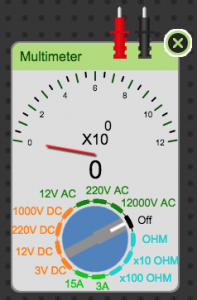
ANALOG MULTIMETER
Students can experiment with this multimeter that measures Selection Knob can be used to easily set the required meter and choose from several ranges of value. Meters to choose from are:
AC Voltmeter
DC Voltmeter
Amperemeter
Ohmmeter
OSCILLOSCOPE VOLTAGE MEASUREMENT

This handy oscilloscope can measure voltage by using realistic leads!

The oscilloscope can measure current also.
OSCILLOSCOPE TIME/DIV, VOLT/DIV SETTING

Students can easily observe the different settings of time base or volts/div that is found in the real oscilloscope, and can chose from multiple functions for each channel.
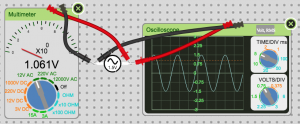
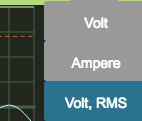 The oscilloscope has multiple functionalities, it can show voltage, ampere and root mean square (RMS). RMS voltage is the most common way to calculate the voltage of an AC circuit. DCAClab calculates RMS by sampling the input voltage and doing the sum-of-the-squares, simulating the high quality voltmeters, both AC meter and oscilloscope has RMS, the oscilloscope plots a dashed line to indicate the RMS.
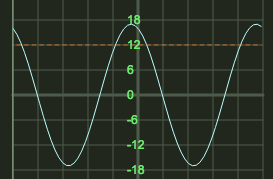
Experiment with multiple wattmeters simultaneously.
CONVENTIONAL / ELECTRON FLOW
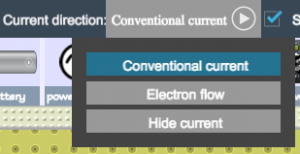 Students can easily observe the current flow animation on both conventional and electron flow.
A B C D RESISTOR COLOR BANDS
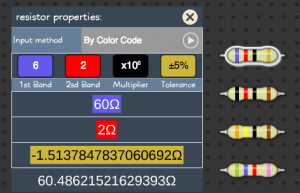 Set resistance using color bands Tolerance is randomly generated according to the selected color of band D Students can change colors of resistor and see the simulation in real time.
RESISTANCE DIRECT VALUE
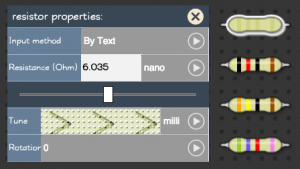 Users can set resistance by writing the value and setting value unit (nano, micro, milli, kilo, mega, giga) Tune slider allows setting modifying value using (nano, micro, milli)

CIRCUIT ANALYSIS USING KIRCHHOFF CURRENT LAW
Current Animation
Easy dynamic circuit analysis for
Kirchhoff’s current law
for schools sales
We are selling DCACLab through FastSpring, our payment processor. FastSpring (which is a US company) will be the vendor in the transaction and their company information will be on your invoice.
W-9 form can be downloaded here: https://www.fastspring.com/w9.pdf