Triode for Alternating Current-TRIAC
A TRIAC (Triode for Alternating Current) is a three-terminal semiconductor device that acts as a bidirectional switch. It is a member of the thyristor family and is equivalent to two Silicon-Controlled Rectifiers (SCRs) connected back-to-back in a single package.
Why use a TRIAC?
The primary reason to use a TRIAC is its ability to control AC power in both directions of the sinusoidal cycle.
-
Full-Wave Control: Unlike standard SCRs, which only conduct in one direction (handling only half the AC wave), a TRIAC handles the entire cycle with a single component.
-
Simplified Circuitry: Using one TRIAC instead of two SCRs reduces the number of components, simplifies the gate triggering circuit, and saves space.
-
Flexible Triggering: It can be turned on with either a positive or negative signal to its gate, regardless of the polarity of the AC supply.
Importance and Key Functions
TRIACs are vital in modern electronics because they provide a bridge between low-power control signals (like from a microcontroller) and high-power AC loads.
-
Phase Control: By delaying the exact point in each AC cycle when the TRIAC “fires” (turns on), it can precisely regulate the average power delivered to a load.
-
Smooth Dimming: This phase control is the “backbone” of modern light dimmer switches, allowing for flicker-free brightness adjustment.
-
Variable Speed Control: They are essential for regulating the speed of AC motors in appliances like fans, blenders, and washing machines.
-
Heating Management: TRIACs provide precise temperature regulation in electric ovens, water heaters, and industrial furnaces by modulating the power sent to heating elements.
-
Solid-State Reliability: Because they have no moving parts, TRIACs serve as long-lasting solid-state relays (SSRs) that switch much faster and more reliably than mechanical switches.
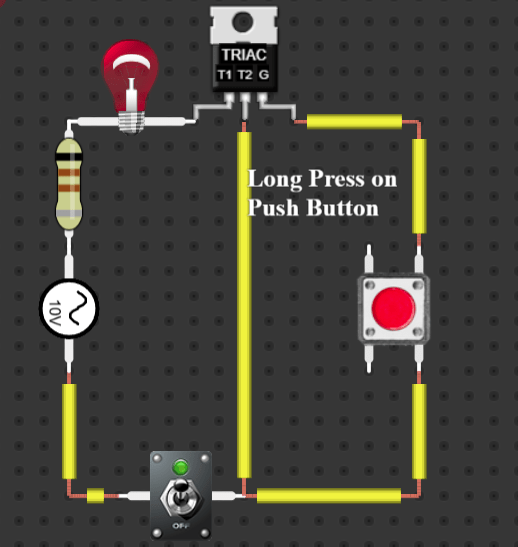
Circuit Link: TRIAC Simple Circuit-DCAClab
In an AC circuit, the behavior of the TRIAC changes fundamentally because the voltage and current are constantly reversing direction and, most importantly, passing through zero.
1. The Zero-Crossing Effect
In AC, the sine wave crosses the 0V mark 100 times per second (for 50Hz) or 120 times per second (for 60Hz).
-
The Rule: A TRIAC will automatically turn OFF whenever the current flowing through it drops below its “holding current” threshold.
-
The Result: Every time the AC sine wave hits zero, the TRIAC “unlatches” and resets to its non-conducting state.
2. Step-by-Step AC Operation
-
Step 1: Standby
The main toggle switch is ON. The AC sine wave is oscillating, but since no signal has hit the Gate (G), the TRIAC remains an open switch. The bulb is OFF. -
Step 2: Triggering (The Push Button)
You press the red push button. A small amount of AC current enters the Gate. The TRIAC triggers and allows current to flow between T1 and T2. The bulb turns ON. -
Step 3: The “Instant” Off
As soon as you release the push button, the Gate signal stops. Within a fraction of a second (less than 1/100th of a second), the AC sine wave reaches the zero-crossing point. -
Step 4: Failure to Latch
Because the current hit zero, the TRIAC turns OFF. Since your finger is no longer on the button to “re-trigger” it for the next half of the sine wave, the TRIAC stays OFF. The bulb turns OFF immediately.
3. Summary Table: DC vs. AC
| Feature | DC Circuit (Your Image) | AC Circuit |
|---|---|---|
| Current Flow | One direction, steady. | Reverses direction (Sine wave). |
| Latching | Yes. Stays on until the switch is flipped. | No. Turns off at every zero-crossing. |
| Push Button | Acts like a “Start” button. | Acts like a “Momentary” switch. |
| Bulb Behavior | Stays ON after one click. | Only stays ON while holding the button. |
How do we keep it “ON” in AC?
In real-world AC applications (like a lamp dimmer), we don’t use a manual push button. Instead, we use a Triggering Circuit (usually a resistor and a capacitor) that automatically “shouts” at the Gate to turn back on at the start of every single half-cycle.
Because this happens so fast (100+ times a second), the human eye cannot see the bulb turning off and on; it just looks like a steady light.